Modern commercial buildings are designed to be visually impressive, spacious, and functional. Large lobbies, atriums, convention centers, shopping malls, exhibition halls, corporate offices, airports, educational facilities, and event venues often feature high ceilings, expansive floor areas, and extensive use of glass, metal, and concrete.
While these architectural elements create an attractive and contemporary appearance, they can also introduce significant acoustic challenges.
One of the most common issues in large commercial spaces is echo.
Excessive echo can make conversations difficult to understand, reduce speech clarity, create uncomfortable listening conditions, and negatively impact the overall user experience. In commercial environments where communication is important, poor acoustics can affect productivity, customer satisfaction, and operational efficiency.
Fortunately, echo problems can be effectively controlled through proper acoustic planning and the strategic use of sound-absorbing materials.
This guide explains why echo occurs and explores the most effective methods for reducing it in large commercial environments.
What Causes Echo in Commercial Spaces?
Echo occurs when sound waves reflect repeatedly from hard surfaces before eventually dissipating.
In large commercial spaces, sound often bounces between:
- Glass walls
- Concrete surfaces
- Stone flooring
- Metal ceilings
- Large windows
- Open architectural structures
Because these materials reflect rather than absorb sound, echoes become more noticeable.
The larger the space, the longer sound reflections continue traveling throughout the environment.
This creates acoustic conditions that can make a space sound noisy, confusing, and uncomfortable.
Understanding Reverberation and Echo
Although the terms are often used interchangeably, reverberation and echo are slightly different.
Reverberation
Reverberation is the persistence of sound after the original source stops. It occurs when multiple reflections blend together within a room.
Echo
Echo is a distinct reflected sound that arrives noticeably later than the original sound.
Both issues are common in large commercial environments and often require similar acoustic solutions.
Controlling reverberation generally helps reduce noticeable echo as well.
Why Echo Is a Problem in Commercial Buildings
Many commercial facilities depend on clear communication.
Excessive echo can negatively affect:
- Speech intelligibility
- Meeting effectiveness
- Customer interactions
- Public announcements
- Learning environments
- Employee productivity
In retail and hospitality environments, poor acoustics can also affect customer experience and overall comfort.
For conference facilities and event venues, echo can significantly reduce the quality of presentations and performances.
Acoustic Wall Panels: A Proven Echo Control Solution
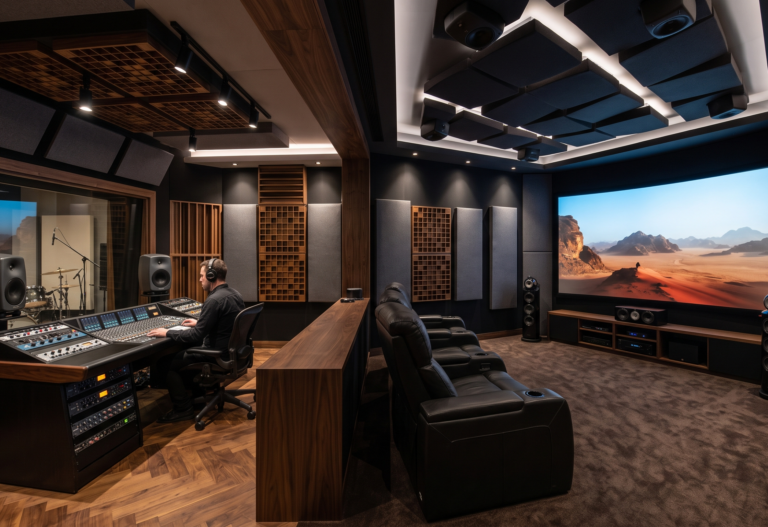
Acoustic wall panels are among the most effective tools for reducing echo.
These panels absorb sound energy rather than reflecting it back into the space.
Popular options include:
- Fabric-wrapped acoustic panels
- Polyester acoustic panels
- Mineral wool acoustic panels
- Decorative acoustic panels
- Perforated wood acoustic systems
When strategically placed on reflective surfaces, wall panels significantly reduce sound reflections and improve overall acoustic performance.
Using Acoustic Ceiling Systems to Control Reflections
In many commercial spaces, ceilings represent the largest reflective surface.
Without acoustic treatment, sound waves repeatedly bounce between floors and ceilings, increasing reverberation.
Common ceiling solutions include:
Acoustic Ceiling Tiles
These absorb reflected sound and improve speech clarity.
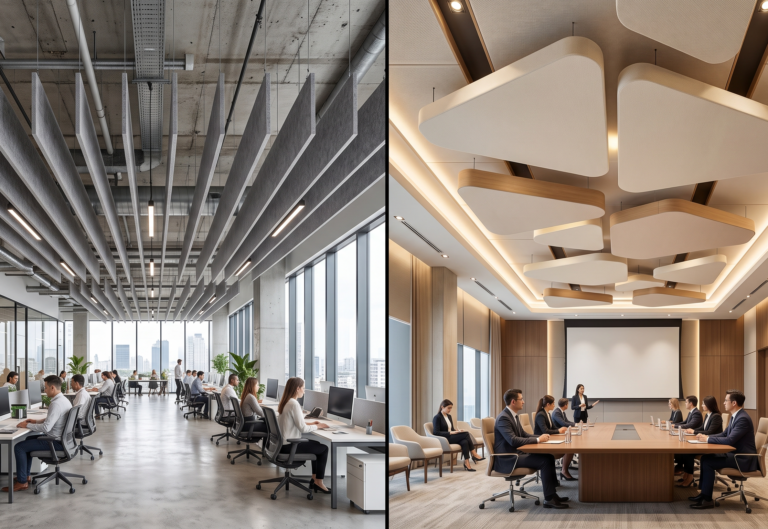
Acoustic Clouds
Suspended horizontal panels positioned below the ceiling structure.
Acoustic Baffles
Vertical suspended elements that absorb sound from multiple directions.
Perforated Acoustic Ceilings
Architectural ceiling systems that combine aesthetics and sound absorption.
Ceiling treatments often provide some of the most effective reverberation control in large spaces.
The Role of Acoustic Baffles in Large Open Areas
Large open spaces often have limited wall area available for treatment.
In these situations, acoustic baffles become extremely valuable.
Baffles are suspended vertically from ceilings and absorb sound from both sides.
They are commonly used in:
- Shopping malls
- Airports
- Manufacturing facilities
- Exhibition halls
- Educational buildings
- Corporate atriums
Their ability to absorb sound while maintaining visual openness makes them particularly effective for large commercial environments.
Installing Acoustic Clouds for Better Sound Control
Acoustic clouds are becoming increasingly popular in modern architecture.
These suspended panels provide:
- Sound absorption
- Architectural appeal
- Flexible design options
- Improved speech clarity
Because clouds are positioned within the sound field, they intercept reflections before they travel across the entire room.
This helps reduce reverberation and create a more comfortable acoustic environment.
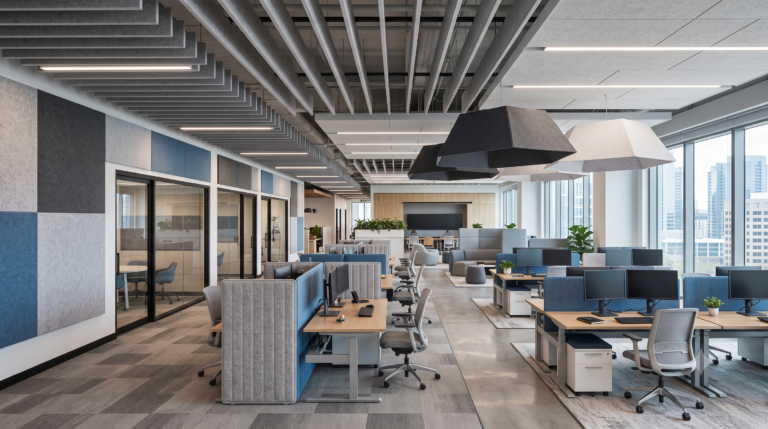
Soft Furnishings and Interior Elements
Furniture and interior finishes also influence acoustic performance.
Large commercial spaces can benefit from:
- Upholstered seating
- Carpets and rugs
- Fabric partitions
- Acoustic furniture
- Decorative absorptive elements
These features help break up reflective surfaces and contribute to overall sound absorption.
Although they may not solve severe echo problems alone, they can support a broader acoustic strategy.
Managing Glass and Reflective Surfaces
Modern commercial architecture frequently incorporates extensive glazing.
While visually attractive, glass is highly reflective acoustically.
Strategies for managing glass-related reflections include:
- Acoustic curtains
- Fabric treatments
- Acoustic wall panels adjacent to glazing
- Sound-absorbing ceiling systems
- Acoustic partitions
Reducing reflections from glass surfaces often delivers noticeable improvements in speech clarity.
The Importance of Room Geometry
The shape of a space significantly influences how sound behaves.
Certain architectural forms can concentrate sound reflections and increase echo.
Examples include:
- Parallel walls
- Large flat surfaces
- Dome-shaped ceilings
- Long corridors
- Highly symmetrical spaces
Acoustic consultants often evaluate room geometry during design and recommend modifications that improve sound distribution.
Acoustic Insulation and Echo Control
Although insulation primarily addresses sound transmission, it can contribute to overall acoustic performance when integrated into wall and ceiling assemblies.
Materials such as:
- Mineral wool
- Rockwool
- Glass wool
- Polyester insulation
help improve acoustic comfort when used alongside sound-absorbing treatments.
The combination of absorption and isolation creates a more balanced acoustic environment.
Sound Absorption vs Soundproofing
A common misconception is that soundproofing materials automatically reduce echo.
In reality, soundproofing and sound absorption serve different purposes.
Sound Absorption
Controls sound reflections inside a space.
Soundproofing
Prevents sound from traveling between spaces.
To reduce echo, the primary focus should be on sound absorption rather than sound isolation.
Understanding this distinction helps ensure the correct acoustic solutions are selected.
Why Early Acoustic Planning Matters
Many commercial buildings attempt to address echo problems after construction is completed.
While improvements can still be made, retrofitting acoustic treatments is often more expensive and less efficient.
Early acoustic planning offers several advantages:
- Better design integration
- Lower project costs
- Improved aesthetics
- Enhanced performance
- Reduced modifications
Acoustic consultants can evaluate potential echo issues before construction begins and recommend solutions that align with architectural goals.
Benefits of Effective Echo Control
Reducing echo provides numerous advantages for building owners and occupants.
These include:
- Better speech intelligibility
- Improved communication
- Enhanced occupant comfort
- Reduced noise fatigue
- Increased productivity
- Better customer experience
- Improved functionality of the space
Acoustic improvements often deliver long-term value that extends far beyond noise reduction alone.
Common Commercial Spaces That Benefit from Echo Control
Echo management is important in:
- Corporate offices
- Shopping malls
- Airports
- Convention centers
- Educational institutions
- Auditoriums
- Restaurants
- Hospitality venues
- Exhibition halls
- Public buildings
Each environment requires a customized acoustic strategy based on its unique function and architectural characteristics.
Conclusion
Echo is one of the most common acoustic challenges in large commercial spaces, particularly in modern buildings that feature expansive open layouts and highly reflective materials.
Fortunately, echo can be effectively reduced through a combination of acoustic wall panels, ceiling systems, clouds, baffles, absorptive finishes, and thoughtful acoustic planning.
The goal is not to eliminate sound entirely but to create a balanced environment where communication remains clear and occupants feel comfortable.
By incorporating acoustic design into the planning process, commercial buildings can achieve both architectural excellence and superior acoustic performance.
A visually impressive space should also sound exceptional—and effective echo control is a critical step toward achieving that objective.
Frequently Asked Questions (FAQs)
What causes echo in large commercial spaces?
Echo occurs when sound reflects repeatedly from hard surfaces such as glass, concrete, metal, and stone.
How do acoustic panels reduce echo?
Acoustic panels absorb sound energy, reducing reflections and lowering reverberation levels.
Are acoustic ceilings effective for echo control?
Yes. Acoustic ceilings are one of the most effective solutions for reducing reflections in large spaces.
What are acoustic clouds?
Acoustic clouds are suspended sound-absorbing panels that help control reverberation and improve speech clarity.
Can carpets help reduce echo?
Yes. Carpets absorb some sound energy and reduce floor reflections.
Is soundproofing the same as echo control?
No. Soundproofing blocks sound transmission, while echo control focuses on reducing reflections within a space.
When should acoustic planning begin?
Ideally during the design stage to maximize effectiveness and minimize future modifications.
Which buildings benefit most from echo control?
Commercial offices, auditoriums, convention centers, educational institutions, malls, airports, and hospitality facilities all benefit from effective echo management.
Contact Stageworks.in
Phone: +91 90150 60000
Email: auditoriumworks@gmail.com
Planning a commercial building, convention center, office, auditorium, educational institution, or public facility?
Our acoustic consulting team helps architects, developers, and project owners design spaces with superior sound quality, reduced reverberation, and improved occupant comfort.