Modern architectural design increasingly favors open, spacious interiors with high ceilings, exposed services, large glass surfaces, and contemporary aesthetics. While these design trends create visually impressive environments, they often introduce acoustic challenges that can affect comfort, communication, and overall functionality.
In commercial buildings, educational institutions, auditoriums, convention centers, airports, restaurants, and open-plan offices, uncontrolled sound reflections can lead to excessive reverberation, poor speech clarity, and uncomfortable noise levels.
To address these issues, architects and acoustic consultants frequently use ceiling-mounted sound absorption systems. Among the most popular solutions are acoustic ceiling baffles and acoustic clouds.
Although both systems are designed to improve acoustic performance, they function differently and are suited to different environments.
Understanding the strengths and limitations of each option helps designers choose the most effective solution for their specific project requirements.
Why Ceiling Acoustics Matter
Ceilings often represent the largest uninterrupted surface within a room.
When sound waves strike hard ceiling surfaces, they reflect back into the space, contributing to:
- Excessive reverberation
- Poor speech intelligibility
- Acoustic discomfort
- Increased noise levels
- Reduced concentration
- Lower occupant satisfaction
In large spaces, ceiling reflections can become one of the primary contributors to acoustic problems.
This is why ceiling treatments often form the foundation of a successful acoustic strategy.
What Are Acoustic Ceiling Baffles?
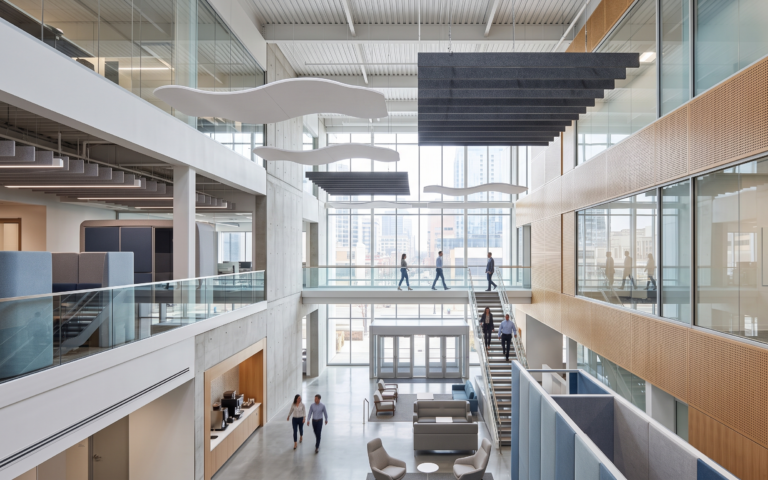
Acoustic ceiling baffles are vertically suspended sound-absorbing panels installed below the ceiling structure.
Unlike traditional ceiling systems that cover the entire ceiling surface, baffles hang downward and absorb sound from multiple directions.
Because both sides of each baffle remain exposed, they provide a large amount of absorptive surface area relative to their footprint.
Acoustic baffles are commonly manufactured using:
- PET polyester panels
- Fabric-wrapped fiberglass
- Mineral fiber materials
- Wood wool acoustic systems
- Custom acoustic composites
Their vertical orientation makes them highly effective in controlling sound within large open environments.
Key Benefits of Acoustic Ceiling Baffles
High Sound Absorption Efficiency
Because sound can reach both sides of the panel, baffles provide excellent absorption performance.
Ideal for High Ceilings
Baffles perform exceptionally well in spaces with significant ceiling height where traditional ceiling treatments may be less effective.
Maintains Architectural Openness
Unlike solid ceiling systems, baffles preserve visual openness while improving acoustics.
Easy Integration with Building Services
Lighting, HVAC systems, sprinklers, and structural elements can often be accommodated more easily around baffle systems.
Contemporary Architectural Appearance
Modern baffle systems are available in a variety of shapes, colors, and configurations that complement contemporary interior design.
Where Are Acoustic Baffles Commonly Used?
Acoustic ceiling baffles are particularly effective in:
- Airports
- Convention centers
- Shopping malls
- Open-plan offices
- Educational institutions
- Manufacturing facilities
- Sports arenas
- Large atriums
- Commercial lobbies
These spaces typically have large volumes and require substantial sound absorption without compromising openness.
What Are Acoustic Clouds?
Acoustic clouds are suspended horizontal sound-absorbing panels positioned below the ceiling plane.
Unlike baffles, clouds are installed parallel to the floor and ceiling.
Acoustic clouds are often used as architectural features while simultaneously improving room acoustics.
They are available in numerous shapes and designs, including:
- Rectangular panels
- Circular clouds
- Custom geometric forms
- Curved configurations
- Multi-layer arrangements
Because they are highly visible, acoustic clouds frequently become an important design element within the space.
Key Benefits of Acoustic Clouds
Excellent Reverberation Control
Clouds absorb reflected sound and reduce reverberation effectively.
Architectural Design Flexibility
They can become focal points that enhance interior aesthetics.
Improved Speech Clarity
Acoustic clouds help create environments where communication is easier and more comfortable.
Customizable Configurations
Clouds can be arranged in numerous layouts to achieve both acoustic and visual objectives.
Compatibility with Modern Interiors
They integrate seamlessly into contemporary architectural concepts.
Where Are Acoustic Clouds Commonly Used?
Acoustic clouds are frequently installed in:
- Auditoriums
- Conference halls
- Corporate offices
- Educational facilities
- Restaurants
- Hospitality venues
- Performing arts centers
- Boardrooms
- Public gathering spaces
These environments often require a balance between acoustic performance and visual sophistication.
Ceiling Baffles vs Acoustic Clouds: Understanding the Differences
Although both systems improve acoustics, several key differences influence their suitability.
| Feature | Acoustic Baffles | Acoustic Clouds |
|---|---|---|
| Orientation | Vertical | Horizontal |
| Surface Exposure | Both sides exposed | Top and bottom surfaces |
| Best for High Ceilings | Excellent | Good |
| Visual Impact | Linear and architectural | Sculptural and decorative |
| Open Space Performance | Excellent | Very Good |
| Design Flexibility | Moderate | High |
| Reverberation Control | Excellent | Excellent |
| Integration with Design | Strong | Very Strong |
The right choice depends on the specific requirements of the project.
Which Solution Provides Better Acoustic Performance?
The answer depends on the characteristics of the space.
In very large open environments with high ceilings, baffles often provide greater sound absorption efficiency because they expose more surface area directly to sound waves.
In spaces where aesthetics play a significant role, acoustic clouds may offer a more attractive and architecturally integrated solution.
Many projects actually combine both systems to achieve optimal results.
Acoustic consultants frequently use hybrid approaches in complex environments.
Choosing Based on Ceiling Height
Ceiling height is one of the most important factors in selecting between baffles and clouds.
For Very High Ceilings
Acoustic baffles are often preferred because they extend vertically into the sound field and provide greater interaction with reflected sound.
For Moderate Ceiling Heights
Acoustic clouds may provide sufficient absorption while contributing more strongly to the architectural character of the space.
Proper evaluation of room dimensions is essential before making a decision.
Aesthetic Considerations
Modern projects increasingly require acoustic solutions that enhance architectural design rather than merely solve technical problems.
Acoustic clouds often offer greater visual flexibility through:
- Custom shapes
- Floating arrangements
- Layered designs
- Sculptural compositions
Meanwhile, baffles create a sleek and contemporary appearance that works particularly well in commercial and industrial-style interiors.
The best solution often depends on the design vision of the project.
Sustainability Considerations
Many acoustic manufacturers now offer environmentally responsible ceiling products.
Popular sustainable options include:
- Recycled PET acoustic panels
- Wood wool acoustic systems
- Low VOC materials
- Recyclable acoustic products
- Sustainable fiber-based composites
Both clouds and baffles can contribute to green building certification objectives when selected appropriately.
The Importance of Acoustic Analysis
Every space behaves differently acoustically.
Factors such as:
- Room volume
- Ceiling height
- Surface materials
- Occupancy levels
- Intended use
- Background noise levels
all influence the effectiveness of ceiling treatments.
Professional acoustic analysis helps determine whether baffles, clouds, or a combination of both will provide the best results.
Common Mistakes When Selecting Ceiling Treatments
Several mistakes frequently reduce acoustic effectiveness:
- Choosing products based only on appearance
- Ignoring room volume
- Using insufficient coverage
- Overlooking reverberation requirements
- Delaying acoustic planning until construction is complete
- Selecting ceiling systems without acoustic testing data
Avoiding these mistakes improves both project performance and long-term value.
Conclusion
Acoustic ceiling baffles and acoustic clouds are both highly effective solutions for controlling reverberation and improving sound quality in commercial environments.
Baffles excel in large open spaces with high ceilings where maximum sound absorption is required. Acoustic clouds offer outstanding acoustic performance while providing greater architectural flexibility and visual impact.
Rather than viewing them as competing solutions, designers should evaluate them as complementary tools within a broader acoustic strategy.
The most successful projects are those that balance acoustics, aesthetics, functionality, and sustainability from the earliest stages of design.
By selecting the right ceiling treatment for the specific application, project teams can create spaces that not only look exceptional but also deliver superior acoustic performance.
Frequently Asked Questions (FAQs)
What is the difference between acoustic baffles and acoustic clouds?
Acoustic baffles are vertically suspended panels, while acoustic clouds are horizontal suspended panels.
Which is better for high ceilings?
Acoustic baffles are generally more effective in very high-ceiling environments.
Do acoustic clouds reduce echo?
Yes. Acoustic clouds absorb reflected sound and significantly reduce reverberation.
Can baffles and clouds be used together?
Absolutely. Many projects combine both systems for enhanced acoustic performance.
Are acoustic ceiling systems suitable for offices?
Yes. Both baffles and clouds are commonly used in open-plan offices and corporate environments.
Do acoustic clouds improve aesthetics?
Yes. They often serve as architectural design features while improving acoustics.
Are sustainable acoustic ceiling products available?
Yes. Many modern ceiling systems use recycled and environmentally responsible materials.
When should ceiling acoustics be planned?
Ideally during the design phase to maximize acoustic performance and architectural integration.
Contact Stageworks.in
Phone: +91 90150 60000
Email: auditoriumworks@gmail.com
Planning an office, auditorium, convention center, educational facility, commercial building, or public venue?
Our acoustic consulting team helps architects, designers, and developers select the most effective ceiling acoustic solutions for superior sound quality and occupant comfort.