Modern commercial architecture increasingly favors open-plan layouts. From corporate headquarters and coworking spaces to technology parks and business centers, organizations are embracing open environments that encourage collaboration, flexibility, and efficient space utilization.
While open-plan offices offer several operational advantages, they also introduce one of the most common workplace challenges: noise.
Conversations, phone calls, office equipment, meeting discussions, movement of people, and building services can collectively create an environment where concentration becomes difficult and productivity suffers.
Without proper acoustic planning, even the most visually impressive office can become an uncomfortable and distracting workplace.
This is why noise control has become a critical component of modern commercial building design.
A well-designed acoustic strategy helps balance collaboration and privacy while creating a comfortable environment that supports employee well-being and business performance.
Why Noise Control Is Important in Open-Plan Offices
Unlike traditional offices with enclosed rooms, open-plan environments allow sound to travel freely across large areas.
As occupancy increases, multiple noise sources begin interacting with one another, creating elevated background noise levels.
Common consequences include:
- Reduced employee concentration
- Increased workplace stress
- Lower productivity
- Poor speech privacy
- Communication difficulties
- Employee dissatisfaction
- Increased mental fatigue
Research consistently shows that excessive workplace noise is one of the leading complaints among employees working in open-plan environments.
This makes acoustic design an essential investment rather than an optional upgrade.
Understanding How Sound Travels in Open Spaces
To effectively control noise, it is important to understand how sound behaves within large commercial interiors.
Sound typically reaches occupants through three primary mechanisms:
Direct Sound
Sound travels directly from a source to a listener.
Examples include conversations, phone calls, and presentations.
Reflected Sound
Sound bounces off hard surfaces such as walls, ceilings, glass partitions, flooring, and furniture.
These reflections contribute to reverberation and overall noise buildup.
Transmitted Sound
Sound passes through partitions, ceilings, doors, and building structures into adjacent spaces.
Effective noise control strategies address all three pathways simultaneously.
Acoustic Ceiling Systems: The First Line of Defense
Ceilings often represent the largest uninterrupted surface in an open-plan office.
Without acoustic treatment, ceiling reflections can significantly increase overall noise levels.
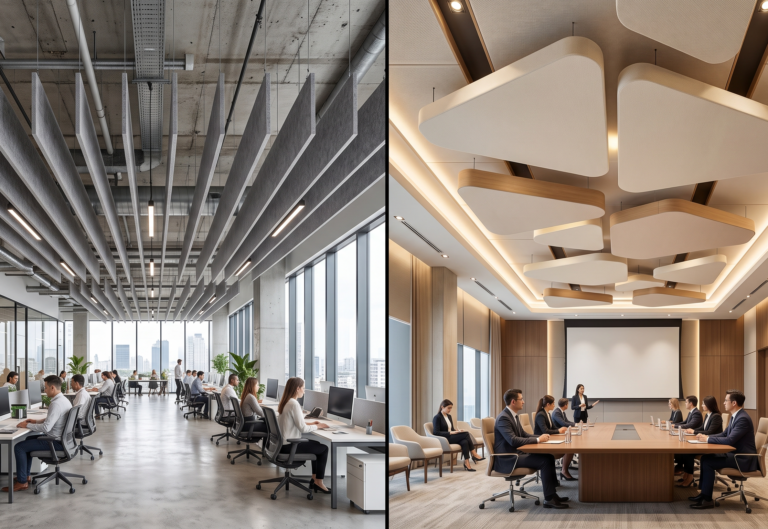
Modern acoustic ceiling systems help absorb sound energy and reduce reverberation.
Popular solutions include:
- Acoustic ceiling tiles
- Mineral fiber ceiling systems
- Acoustic clouds
- Suspended ceiling baffles
- Fabric-wrapped ceiling panels
- Perforated acoustic ceilings
High-performance ceiling systems improve speech clarity while reducing distracting background noise.
For most commercial projects, ceiling treatments deliver some of the highest acoustic returns on investment.
Using Acoustic Wall Treatments
Walls play an important role in controlling sound reflections.
Large glass surfaces, concrete walls, and hard finishes often create excessive reverberation in open spaces.
Acoustic wall treatments help absorb reflected sound and improve overall acoustic comfort.
Common options include:
- Fabric-wrapped acoustic panels
- PET polyester acoustic panels
- Wood wool acoustic panels
- Perforated wood systems
- Decorative acoustic wall features
Modern wall treatments are available in various colors, patterns, and finishes, allowing architects to combine acoustic performance with interior aesthetics.
Strategic Space Planning for Noise Control
One of the most effective noise control strategies begins before construction even starts.
Careful space planning can significantly reduce acoustic conflicts.
For example:
- Meeting rooms should be separated from focused work areas.
- Collaborative zones should not be placed beside executive offices.
- Breakout spaces should be isolated from quiet workstations.
- High-traffic circulation paths should be planned carefully.
Proper zoning helps prevent noise-generating activities from disrupting employees who require concentration.
The Role of Acoustic Partitions
Open-plan offices do not necessarily mean completely open spaces.
Acoustic partitions help create visual and acoustic separation without sacrificing flexibility.
These may include:
- Desk-mounted screens
- Modular acoustic dividers
- Freestanding acoustic panels
- Glass partitions with acoustic interlayers
- Mobile partition systems
Partitions reduce direct sound transmission and improve speech privacy between workstations.
Flooring Solutions That Reduce Noise
Floor finishes can influence acoustic performance more than many people realize.
Hard flooring surfaces reflect sound and amplify footfall noise.
Acoustically friendly flooring materials help reduce these effects.
Popular options include:
- Carpet tiles
- Acoustic vinyl flooring
- Rubber flooring systems
- Underlayment sound insulation
These materials contribute to a quieter and more comfortable workplace environment.
Managing Speech Privacy in Open Offices
Speech privacy remains one of the most challenging aspects of open-plan design.
Employees frequently need to conduct confidential discussions, client calls, and focused work activities.
Acoustic strategies that improve speech privacy include:
- Sound-absorbing ceilings
- Acoustic partitions
- Meeting room enclosures
- Strategic workstation layouts
- Sound masking systems
A balanced approach allows communication where needed while protecting privacy in sensitive areas.
Sound Masking Systems
Sound masking has become increasingly popular in modern commercial buildings.
Unlike traditional noise control methods that reduce sound, sound masking introduces carefully engineered background sound to reduce speech intelligibility over distance.
Benefits include:
- Enhanced privacy
- Reduced distractions
- Improved workplace comfort
- Better concentration
Sound masking systems are often integrated into high-performance workplace acoustic strategies.
Reducing HVAC and Mechanical Noise
Mechanical equipment can become a major source of workplace noise if not properly controlled.
Common sources include:
- Air handling units
- HVAC ductwork
- Fans
- Pumps
- Electrical equipment
Acoustic consultants often work closely with MEP engineers to ensure that building services meet acceptable noise criteria.
Controlling mechanical noise contributes significantly to overall workplace comfort.
Using Sustainable Acoustic Materials
Many organizations today prioritize sustainability alongside performance.
Fortunately, modern acoustic products support both objectives.
Popular sustainable acoustic materials include:
- Recycled PET acoustic panels
- Wood wool acoustic systems
- Low VOC acoustic materials
- Sustainable ceiling treatments
- Recycled-content insulation products
These solutions improve acoustics while supporting environmental goals and green building certifications.
The Importance of Acoustic Planning During Design
Many noise problems arise because acoustics are considered too late in the project.
Retrofitting acoustic solutions after occupancy is often expensive and disruptive.
Early acoustic planning provides several advantages:
- Better design integration
- Lower project costs
- Improved occupant comfort
- Reduced modifications
- Enhanced workplace performance
Acoustic consultants can evaluate noise risks before construction begins and recommend solutions that align with project objectives.
Benefits of Effective Noise Control
Organizations that invest in workplace acoustics often experience measurable benefits.
These include:
- Increased productivity
- Improved employee satisfaction
- Better communication
- Enhanced concentration
- Reduced workplace stress
- Improved occupant well-being
As businesses continue to prioritize employee experience, acoustics are becoming an increasingly important component of commercial building design.
Conclusion
Open-plan commercial buildings offer flexibility, collaboration, and efficient use of space, but they also create unique acoustic challenges.
Without proper noise control strategies, excessive sound can negatively affect productivity, communication, and employee well-being.
By combining acoustic ceilings, wall treatments, partitions, flooring solutions, sound masking systems, and intelligent space planning, organizations can create workplaces that support both collaboration and concentration.
The most successful open-plan offices are not necessarily the quietest—they are the ones where sound is effectively managed to support the needs of the people using the space.
Acoustic design is ultimately an investment in workplace performance, employee satisfaction, and long-term business success.
Frequently Asked Questions (FAQs)
Why are open-plan offices noisy?
Open spaces allow sound to travel freely, creating higher levels of background noise and speech distractions.
What is the best acoustic solution for open offices?
A combination of acoustic ceilings, wall treatments, partitions, and sound masking systems typically provides the best results.
Do acoustic ceiling panels reduce office noise?
Yes. Acoustic ceiling systems absorb sound reflections and help reduce reverberation.
What is sound masking?
Sound masking introduces engineered background sound to reduce speech intelligibility and improve privacy.
Can acoustic partitions improve productivity?
Yes. They reduce distractions and create more focused work environments.
How do acoustic wall panels help?
They absorb reflected sound and reduce overall noise buildup within the space.
When should acoustics be considered during a project?
Ideally during the planning and design phase to maximize effectiveness and reduce costs.
Can sustainable acoustic materials provide good performance?
Absolutely. Many eco-friendly acoustic products offer excellent sound absorption and noise control capabilities.
Contact Stageworks.in
Phone: +91 90150 60000
Email: auditoriumworks@gmail.com
Planning an open-plan office, corporate headquarters, coworking space, commercial building, or business center?
Our acoustic consulting team helps architects, designers, and developers create productive and comfortable workplace environments through effective noise control and acoustic design solutions.